


Our Learning Model
At Humberston Park School we are proud of our approach to learning. Based on years of best-practice, research findings and continual innovation, our transdisciplinary learning model focuses on giving each pupil the very best experiences enabling personalised outcomes relative to their needs, desires and aspirations.
Explaining Our Learning Offer
Purpose
Purpose …engaging children and young people in creative and enjoyable learning that’s of functional value to them now and in their future lives.
Values
Inclusiveness: enabling each pupil to take an active and positive role in their social environment, at home, in School and in the community, according to socially accepted standards of behaviour, and to create an awareness of moral and cultural values…
Independence: maximising each pupil’s capacity for independent living, their full potential for intellectual and physical development and their ability to act autonomously…
Enjoyment: increasing every pupil’s capacity for enjoyment through the provision of creative and meaningful experiences…
Strategic Areas: leading improvement…
Leadership ensures:
Professional Practice ensures:
Transdisciplinarity & Learning ensures:
‘Within-Between-Beyond’ …where we’re heading
Ensuring meaningful life experiences through inclusion and transdisciplinary working…
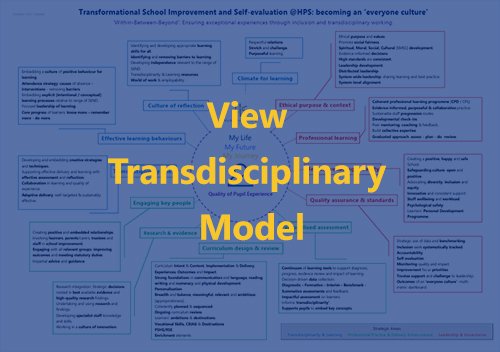
Transdisciplinary Model
Our Purpose is supported by our transdisciplinary approach which recognises four fundamental areas of need:

Communication & Interaction

Cognition & Learning

Personal, Social, Emotional & Health education including Mental Health & Wellbeing

Physical & Sensory
Transdisciplinary Teams & the ICF Framework
Five teams that work together, focussing on developing the quality of pupils’ experiences.
Three teams focus primarily on Child Development aspects:
- Total Communications Solutions team
- MOVEment for Learning & Life team
- Complex Health Care team
Two teams focus primarily on Resource Development aspects:
- Curriculum Design & Review team
- Environment Solutions team
All teams work together through intense collaboration, and merge multiple knowledge streams and skill sets to develop new innovative and creative approaches to ensure each pupil receives meaningful and relevant, personalised input, that is flexible in nature to meet their needs at any time.

Each team has a known and shared purpose – each team has agreed ‘expected outcomes’ that they have discussed and agreed, whilst also identifying projected longer term, sustainable impacts on pupils.
Our teams model structure also supports the School’s improvement and self-evaluation framework.
Specialist staff recruitment, training and professional development/learning are key across all teams. This builds specialist knowledge and techniques, motivates staff and helps embed practice.
Our transdisciplinary approach and understanding is also guided by The International Classification of Functioning, Disability and Health, known more commonly as ICF; the ICF is a classification of health and health-related fields.
As the functioning and disability of an individual occurs in a context, ICF also includes a list of environmental factors.
Curriculum Intent: Whole-School overview
What we’re trying to achieve: Our Intentions
- …working with pupils and their families to provide individuals with skills, abilities and attitudes that are useful to everyday life.
- Promote effective communication and other literacy skills to express needs, desires, ideas and feelings and to comprehend those of others.
- Promote conceptual development and numeracy skills.
- Promote knowledge and understanding of the world.
- Exploit the individual’s potential to acquire physical capabilities which minimise dependence on others for self-care, sustenance, movement and social mobility.
- Help individuals to develop personally and socially enabling them to make choices, behave appropriately, form relationships and develop healthy life-styles.
- Provide opportunities for the development of self-esteem and confidence.
- Promote individual’s potential for full sensory, imaginative and creative development through the provision of a range and variety of experiences.
- Promote moral and spiritual development.
- Extend and supplement the individual’s natural abilities and interests in sporting and artistic activities including health, fitness and leisure activities.
My Day [A]
My Life – My Future – My Journey
Every pupil has a personalised ‘My Day’ which ensures all the important building blocks for improving their quality of life are assessed then prioritised each day by our transdisciplinary teams.

Assessments
Our range of assessments act as a continuum of learning tools to support diagnosis, progress, evidence review and impact of learning.
a. DiagnosticThese assessments are completed at the start of pupils’ journeys. These help Gauge pre-knowledge / skills. Used to help determine approach – what next – strategy.
| When applicable the following assessments are used upon admission into School to gain a baseline of current skills/areas of development. Affective Communication Assessment Levels of Attention Derbyshire Language Scheme [Rapid Screen Test] Pre-Verbal Communication Schedule DUNST Ordinal Scales [Cognitive functioning] Wellbeing Profile Motivational Assessment Social Use of Language Programme Visual Profiles
|
b. FormativeUsed during a process / learning / session / lesson / day / week / month / year. Help determine progress, including maintenance and lateral progress. Helpful in providing adjustments to provision / practice needed?
| The following are yearly reviewed during the formal assessment period [however, some are done at other times as required]. Affective Communication Assessment Levels of Attention Derbyshire Language Scheme [Rapid Screen Test] Pre-Verbal Communication Schedule DUNST Ordinal Scales [Cognitive functioning] Engagement Framework Assessment for Learning [AfL] PSHE PROA Emotions PROA Behaviour Star Charts Visual Impairment Tracker Hearing Impairment Tracker Phonics Assessment Tracker Phonic Starting Strong Social Use of Language Programme
|
c. InterimUsed to compare results of groups / cohorts / classes / Key Stages / Phases. These assessments help build an overview of impacts / progress.
| Transdisciplinary Impact Assessment Framework Earwig Phonics Starting Strong CASPA |
d. BenchmarkThese assessments measure relative progress against similar groups / cohorts [CASPA percentiles]
| CASPA National Curriculum Assessments |
e. SummativeSuccess / impacts measured at the end checkpoint. Reviews performance. Used to explore how / what to improve.
| ATAS: our documents which compile assessment information Transdisciplinary Impact Assessment Framework PACE2 PROA Visual Impairment Tracker Hearing Impairment Tracker National Curriculum APP Assessments Phonics Assessment Tracker
|
ATAS 1 & 2
ATAS 1 captures ‘Assessment Priorities’ identified from baseline and ongoing assessment. The priorities link through a pupil’s EHCP Learning Outcomes and small step targets, and their Individual Education Plans.
ATAS 2 summarises strengths and areas for development, relative to identified priorities in ATAS 1, across:
Wellbeing – Attention – Engagement – Communication – Medical – Behaviour – Learning to Learn.
EHCPs – Education, Health & Care Plans
We use each pupil’s EHCP to identify current Learning Outcomes that have been agreed with the pupil [where appropriate], parents/carers and relevant professionals, including the School teams.
‘My Day’ [B]
Individual Education Plan
Informed by Learning Outcomes in the pupil’s EHCP, targets are set [records start level, start date and date achieved] relative to the following areas:
- Communication & Interaction
- Cognition & Learning
- Social, Emotional & Mental Health
- Sensory / Physical
Wellbeing
Profiles Health & Wellbeing information / needs.
Learning Programmes
In order to address the complexities across the diversity of cognitive, medical, physical , sensory and care needs, our Transdisciplinary Curriculum is built using Core, Therapeutic and Life Skills elements: all elements are part of each pupil’s learning experience and are not delivered on their own but delivered / implemented together with intense collaboration, merging all professionals’ knowledge and skills.
Our overall intention is to provide an ambitious curriculum, which is motivating and engaging that allows pupils to achieve and make progress in their own personalised way, based on their own assessed levels. The curriculum is designed to enable pupils to develop the skills that they will ultimately need as adults in order for them to have the greatest level of relative independence and lead the most fulfilled life in their communities.
Our curriculum implementation starts with high-quality, specialist support. The transdisciplinary team use their knowledge and assessment of pupil’s individual abilities to place them on the correct learner Journey and identify key priority areas. Emphasis is placed on supporting our pupils to learn the skills that they need in order to be more independent and ready for learning. We recognise that without the development of these skills over time, learning will not be maintained and our pupils are unlikely to reach a level of mastery. Therefore, our curriculum is implemented using three personalised journeys, which allow different pupils to develop appropriate skills for their academic and developmental level and learning style.
We recognise that achievements based on linear academic progress alone, do not always give us a whole child picture and can sometimes hide some key important small steps of progress that have been achieved by our unique learners.
Despite all the personalisation across our offer, some things are universal for all our pupils and this is how we want to judge the impact of our curriculum:
- We are able to demonstrate and recognise achievement for all pupils and celebrate
- All our pupils are suitably prepared with skills that will help them in adulthood.
- Attending and learning at Humberston Park School is a positive, motivating experience where pupils feel safe.
Four areas of learning form the core curriculum.
Literacy
Numeracy
PSHE/RSE
Physical Development
The consultative model is used within both therapeutic areas in which therapy goals and programmes are embedded within the school’s My Day approach. Through a transdisciplinary approach staff are coached and trained to deliver and monitor these interventions.
MOVEment for Learning & Life and Physiotherapy
- Posture, balance and coordination.
- Functional skills and movement patterns
- Quality of life.
- Interaction skills.
- Exploring Senses
- International Classification of Functioning, Disability and Health (ICF)
- Body Structures and Functions [Impairments]
- Activities [Limitations]
- Participation [Restrictions]
- Environment [Barriers]
- Personal Factors
Total Communication Solutions
- Augmentative and Alternative Communication (AAC)
- Eye Gaze Technology
- Exploring Senses
- Phonology
- Early Sound Making
- Pragmatics
- Narrative
Complex Health Care
- Specialist neurological disorder support.
- Specialist developmental disability support.
- Specialist support for chronic health conditions, heart disease and terminal illness.
- Sports & leisure.
- Music, singing and dance.
- The world we live in [Humanities, including RE].
- Mini enterprise.
- Community work.
- The Shop.
- Administration support.
Learner Journeys
Fundamental learning streams across phases to focus on needs, learning difficulties and aspirations
We acknowledge that different types of learning experiences are needed for personalised learning. Our curriculum therefore offers every pupil the chance to be successful.
The transdisciplinary team use their knowledge and assessment of each pupil’s individual abilities to place them on the most appropriate Learner Journey and identify relevant and meaningful priority areas. Importance is placed on developing the skills that they need in order to be ready for learning and more independent, and we recognise that without the development of these skills over time, learning will not be maintained and our pupils will not reach a level of mastery. Therefore, our curriculum is implemented using three personalised Learner Journeys, as below, which allow pupils to develop appropriate skills for their academic and developmental level and learning style.
Experience for Life
Experience for Life is a therapy-based Learner Journey which offers opportunities and enriching experiences for pupils with complex physical, medical and sensory needs. The Journey has been designed to enable pupils to have a richer, more meaningful quality of life and community inclusion. Delivered through transdisciplinary specialist provision to support complex healthcare and educational needs, the Journey enables focus on communication, physical and sensory development, and functional and social skills, which encourage and nurture greater independence.
High levels of support and small groups are key to achievement.

Learning for Life
Learning for Life provides stimulating and challenging learning opportunities for pupils with significant intellectual / cognitive impairments and communication and perception difficulties. This Learner Journey has been designed to offer specific emphasis on personalised communication, emotional regulation, social skills, literacy and numeracy. The Journey enables each pupil to maximise their individual potential towards personalised levels of independence, leading to meaningful and relevant experiences of the world and communities around them.
High levels of support and small groups are key to achievement.

Skills for Life
Skills for Life provides focus on achieving personalised outcomes specific to each individual’s aspirations for pupils who have difficulties around literacy and numeracy and need to develop social, independence and communication skills to help them gain purposeful community involvement. The Learner Journey has been designed to help equip them with functional and relevant transferable skills. Emphasis is on independence and work-related learning skills to empower them to develop self-advocacy, autonomy and personal character, delivered through exciting, engaging, challenging and motivational learning opportunities, by providing occasions to access the community to make positive contributions to citizenship.
Opportunities for independence and autonomy in a range of group sizes and individual circumstances are key to achievement.

Challenging our more able learners…
Challenging our more able learners at HPS requires a personalised approach that recognises and builds on their strengths while accommodating their individual needs and aspirations. By implementing such approaches, we can effectively challenge the more cognitively able pupils, ensuring that they are engaged, motivated, and able to reach their full potential, through appropriate experiences and encounter.
Commonly, across the School, staff will challenge our more able pupils using a range of strategies and approaches that can be seen below…
However, we also recognise that challenging pupils in our Early Learners phase requires very different approaches to challenging those young people in our 16-19 prevision.
So, to ensure appropriate ‘psychogogic challenge’, at HPS we have combined our transdisciplinary approach with psychogogic theory to ensure appropriate strategies of challenge for relative cognitive and age-related encounter in our Early Learners, Primary, Secondary and 16-19 phases: these are in addition to those listed below.
- Professional Learning for Staff: at HPS we ensure that all staff members are trained with appropriate and specialist skills and can better identifying opportunities for challenging more able pupils.
- Personalised Learning Plans: developing PLPs that set specific small steps, targets and learning outcomes, based on detailed assessments of each pupil’s abilities, needs and interests, ensuring that challenges are appropriately pitched.
- Adaptive Learning: adapting learning facilitation provides changeable levels of complexity and support. This can involve modifying tasks, providing extension activities, or offering different resources to match and/or stretch the pupil’s ability level.
- Enrichment Activities: providing enrichment activities that go beyond the standard ‘curriculum expectations and content’, we can include advanced projects, independent learning opportunities, or exploration of learning in wider/greater depth.
- Using Technology: at HPS we leverage assistive and adaptive technology to provide challenging tasks that are accessible to more able pupils. Educational software and online resources can offer wider and more challenging personalised learning experiences.
- Critical Thinking & Problem-Solving: by incorporating activities that promote critical thinking and problem-solving skills, we encourage pupils to engage in inquiry-based learning, where they ask questions, investigate, and show their findings.
- Subject-Specific Challenges: identifying specific subjects or areas where a pupil shows exceptional ability, we’re able to provide targeted challenges in these areas.
- Additional Opportunities: by encouraging participation in supplementary activities such as School Council, external clubs, competitions, and external courses, HPS can provide additional challenges and opportunities for growth.
- Flexible Grouping: we use flexible grouping strategies to place more able pupils with peers who have similar abilities or interests for certain activities. This allows for more tailored and personalised learning and greater peer support opportunities.
- Focus on Strengths, High-Likes & Interests: by building on pupils’ strengths and interests to further motivate and engage them., we can adapt challenges to align with what they enjoy and excel at, making learning more relevant and stimulating.
- Feedback & Reflection: we’re able to provide regular, constructive feedback that helps pupils understand their progress and areas for improvement. By encouraging self-reflection, more able learners can set their own next steps and targets and take ownership of their learning.
- Transdisciplinary Availability of Specialists: involving our internal transdisciplinary specialists and external professionals helps to provide additional support and strategies for challenging more able pupils.
- Inspiring Independence: at HPS we foster independence by developing and facilitating self-regulation and executive functioning skills, providing opportunities for pupils to make choices about their learning and to take on responsibilities within the classroom, in School Council and across the School in general.
- Parent/Carer Involvement: we engage parents and carers in the learning process, with the aim of providing them with strategies and resources to support and further challenge their child’s development at home, creating a consistent and enriching environment for learning.
If you would like further information/details about our curricula, please contact:
Kelly Mitchell, for Early Learners & Primary mitchellk@hpark.org.uk
Mel Farrow-Browne, for Secondary harrisonm@hpark.org.uk
Jessica Dawes, for 16-19 dawesj@hpark.org.uk