


Welcome to our Early Learners
Guiding Principles Early Learners Phase 3Is 2024
Our Learning Environments for Early Learners…
We have three ‘bases’ within in our Early Learner environment.
All three bases have personalised themes that are set up to provide the children with the space to explore, learn and develop.
Children are given the best educational start within our stimulating, fun and nurturing environment both indoors and outdoors.
We aim to provide caring and secure environments for all physical, sensory, medical and educational needs in which your child can learn and develop through contrasting combinations of structured and free play.
Our specialist staff provide learning opportunities in the most fun and imaginative ways, developing strong relationships with every child, so they can tailor the support to their individual needs and interests.
This connection gives the children a real sense of belonging within our community, creating a confidence and reassurance that carries them through their journey throughout their school years.
We have a large outdoor area in Early Learners, sectioned into three discrete zones, which are designed to be fully inclusive for the range of needs of the children.
Our Flexible access arrangements allow us to create one large free-flowing space if needed.
Our grassed areas with trees allow pupils to enjoy sensory feedback from nature.
We also have outdoor areas which are perfect for stories and small group play and exploration.
Most of our outdoor learning areas are covered so these spaces can be used all year round.
Key Worker
Each pupil will be assigned a key worker. This is a member of staff in class who takes specific interest in that child’s developmental milestones, wellbeing and overall achievements.
The Key Worker will ensure that the child’s learning is tailored to meet their personal needs, and will find out about their preferences and routines.
The Key Worker will be responsible for building up relationships with the pupil, their family/carer, and other key people involved in the child’s life, so that together, we ensure the highest quality experiences for the young person.
Visit us…
If your son or daughter has an EHCP and their learning needs fit our admission profile, we recommend that you contact us to arrange a visit in the first instance.
During the visit…you’ll have a tour of our School with an experienced member of our Leadership Team, giving you an opportunity to see what HPS offers and how we do things…differently…and better.
We will make you feel welcomed and relaxed – you can ask questions – see the range of learning environments – experience pupils’ personalised learning – meet our brilliant staff – see the resources and facilities.
Preparing your child for HPS
We understand that choosing the right school for your child is a significant decision.
We’re here to make the transition process in to Humberston Park School as simple as possible. Our aim from the start is to build a strong relationship with the family and the child.
Experienced staff will ensure your child is happy and content throughout the transition into Humberston Park School.
Once your child’s place at HPS has been confirmed, you’ll be sent a ‘New Starter Welcome Pack’ that includes all the information you require for a smooth and supportive transition into the School.
We believe that clear and regular communication between the School and family is key to success.
For further details please see the Admission Transition Process below.
Early Learner Admission Transition Process
- Consultation between family, Local Authority and HPS
- Place Offered [if consultation successful and our placement criteria are met]
- New Starter Welcome Pack sent out: Key Worker and Class Team assigned
- EHCP Learning Outcomes reviewed and agreed & ‘My Day’ developed
- Stay & Play Session arranged: meet Key Worker and Class Team Lead – Experience the learning environment
- Pre-admission paperwork completed
- Health Care Plan set up
- Start date agreed
- Preparation for transition developed with child, family, current setting and Humberston Park School, including equipment requirements, medication requirements and specific staff training
Pre-admission
This meeting/process will focus on everything to do with your child: it is important that their ‘voice’ is heard as well as yours.
Information gathered during the meeting will help us build a wellbeing profile which records such things as the child’s ‘likes’ and ‘dislikes’, parental educational wishes, and also supports any medical care planning and therapy interventions.
As part of this process, experienced members of Humberston Park School staff will visit the child at home and also in their current educational setting to ensure as much meaningful and relevant information is gathered to support a smooth transition to HPS.
Child and family’s experience
Stay and Play Sessions
These sessions take place before your child is on roll.
We would love you to come with your son/daughter to one of our Stay and Play sessions which are a fun way to familiarise yourself and your child with the new environment and the staff team. These sessions are a good opportunity to meet your child’s Key Worker and for the relationship to begin.
There is no maximum number of sessions, as these are designed to meet the personal needs and requirements of the young person so they feel safe, happy and engaged at their new School. Stay and Play sessions also support you as the parent/carer to feel more confident with the relationship with HPS and the staff involved with your child’s health, care and education.
When the time is right and all involved are in agreement, the next exciting step is for your son/daughter to begin their journey as a fulltime learner at HPS.
Enrolment for Early Learners at HPS
Before starting on their first day at HPS, your son/daughter will have already been set up with the necessary equipment and resources they need through previous meetings with our transdisciplinary team, including where appropriate, our Consultant Physiotherapist, our Specialist Speech and Language Therapist and the Children’s Complex Health Nurse.
A medical care plan will have been produced for you and staff to follow.
A personalised assessment file, My Day, will be put in place which will include your child’s current Learning Outcomes from their EHCP. The file will also contain a one-page profile that identifies all the important building blocks to be assessed to improve their quality of life; these are then prioritised. To complete the assessment file, a health and wellbeing section covers your child’s pertinent information and relative needs to ensure a truly holistic approach.
When your son/daughter has settled into their routine, our transdisciplinary team will use their knowledge and skills to decide which Learner Journey will best suit your child: please refer to our Learning Model for more detailed information. As the parent/carer, you will also be part of this Journey, receiving support and advice throughout.
Introducing Health & Therapy

Physiotherapy & MOVE

Complex Health Nursing
Speech and Language Therapy
Therapy delivery: how it works at HPS
A consultative model is used by our Consultant Physiotherapist and Specialist Speech and Language Therapist.
Both therapists have an open referral system in which referrals can be made to each of the services in relation to specific referral criteria. If the referrals are appropriate, the pupil will then receive an assessment and recommendations for therapeutic interventions. The therapy goals and programmes are embedded into class through transdisciplinary working, supporting pupils to access learning. Therapeutic programs are carried out and monitored by class staff as part of the My Day approach. The open referral system supports review and reassessment process.
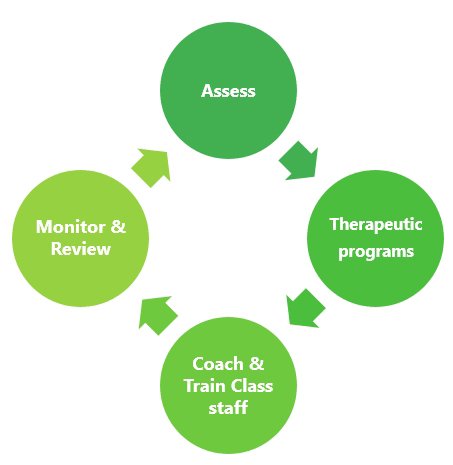
Therapy delivery: Transdisciplinary approach
This approach employs working with all those areas involved in a child’s journey: before, during and after their school experience.

Therapy Provision
Our focus is on developing needs-led skills
Children access different parts of the SALT & Physiotherapy provision as required to support their identified skill requirement and outcome attainment. This means that pupils may access some, all, or a combination of the wide range of interventions for short bursts or on/off periods across their time at Humberston Park School.
As the young person settles in to their new environment they will be embraced into the School-wide Total Communication & Movement for Learning & Life approach.
Our specialist Speech and Language therapist is the Total Communication Solutions Lead and overseas specialist training for staff to ensure that they enable the most positive communication in a person-centred way.
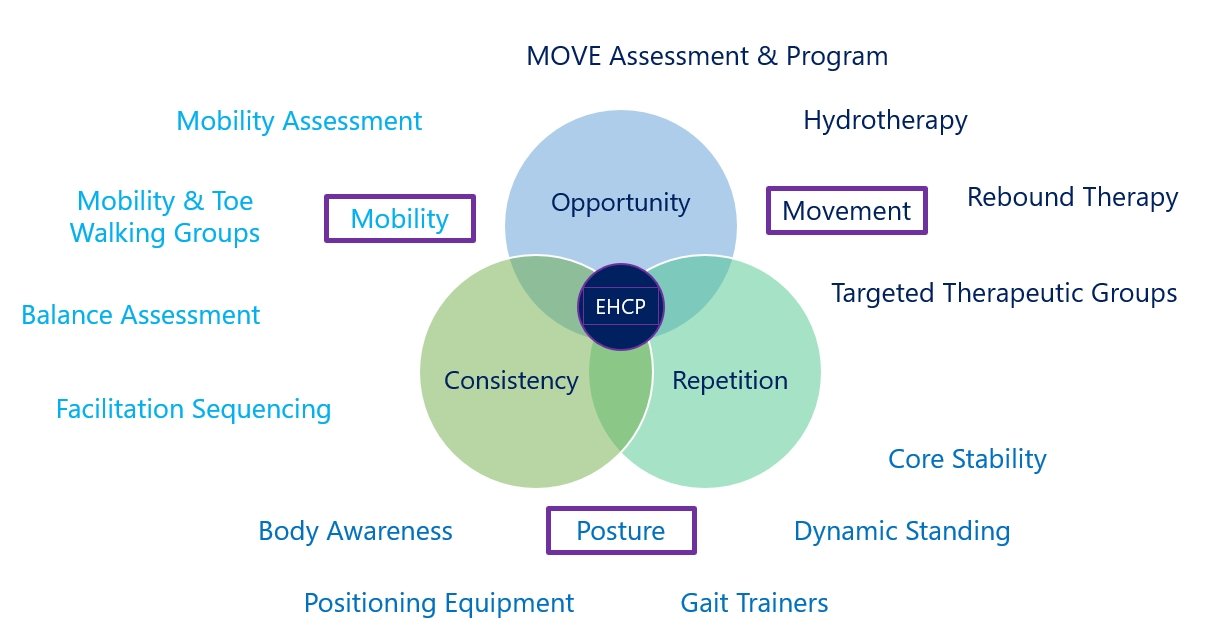
Our consultant physiotherapist is the MOVEment for Learning & Life Lead and overseas specialist interventions and training for staff, to ensure that they enable the most positive and appropriate motor skill development in a pupil-centric way.
All class-based information and assessment forms a rich knowledge base from which, if appropriate, direct specialist assessment can be applied.
Following SALT & Physiotherapy assessment the pupil and family will receive a report outlining small-step targets which will be implemented by the class team. The aim for every pupil who receives a SALT and/or Physiotherapy assessment is that they will have a clinical evidence-based assessment with clear clinical outcomes from which they can develop their communication and physiotherapy-linked skills.
Physiotherapy
Speech and Language Therapy

Children’s Complex Health Team
- Ensure every pupil has a personalised Health Care Plan
- The CCHT support School staff with pupils’ on-going health and care needs
- Provide clinical training to staff, and monitor competencies
- Provide families with information, guidance and advice about other health/care services and resources
- The CCHT are involved in referral of pupils to other services/agencies, as required
- They also support pupils’ continuity of care by attending or contributing towards meetings relating to but not limited to, EHCPs, Annual Reviews, CIN and TAF.
Challenging our more able pupils in Early Learners…
In our Early Learners at HPS we use a nuanced approach that is both stimulating and supportive. By implementing these specific strategies below, we effectively challenge the more able Early Learners, ensuring that their learning experiences are enriching, stimulating, and supportive of their individual growth and development.
- Play-Based Learning: we utilise play as a medium for learning. Structured play activities that incorporate more complex tasks and problem-solving can be highly effective. For example, setting up a play scenario that requires sorting, categorising, or building can engage our more able Early Learners in higher-level thinking.
- Use of Technology: by integrating assistive technology and educational apps designed for our Early Learners, we can offer a range of personalised challenges and interactive learning experiences that adapt to the child’s level of ability.
- Encouraging Thinking: if we incorporate activities that promote thinking and problem-solving skills, where more able pupils are able to investigate and evaluate experiences, including puzzles, cause-and-effect toys, and games that require decision-making, we’re aware this can stimulate more able pupils’ learning.
- Peer Interaction: by facilitating peer interactions through group activities and/or pair work our more able Early Learners benefit from engaging with peers at different ability levels, fostering social skills and opportunities for collaborative learning.
- Scaffolded Support: providing scaffolded support that gradually increases in complexity, begins with more guided support and slowly reduces as a child becomes more competent, encouraging greater independence and more confidence.
- Focus on Interests: identifying and building upon each child’s interests enables the Early Learner team to tailor activities to align with what excites and motivates our more able Early Learners, making learning more relevant and engaging.
- Varied Facilitation: by using a variety of transdisciplinarity and learning methods, including hands-on activities, sensory play, and experiential learning, we ensure that Early Learners are exposed to a range of levels of challenge, and learning strategies and activities.
- Outdoor Learning: by taking advantage of our outdoor spaces, activities like nature walks, outdoor play, and exploration provides rich, multi-sensory experiences that can be tailored to challenge more able pupils in different ways.